19 L or 10 L: Which Water Bottle Size to Choose
Aqua Element offers two bottled-water formats: the classic returnable 18.9-litre bottle (commonly called "19 L") and a more compact 10-litre bottle. We do not produce other sizes — that is a deliberate choice. Two formats cover almost every home and workplace scenario in Tashkent, from a single person to a twenty-person office.
This article is not a marketing brochure but a practical decision guide. We will go through weight, cooler compatibility, the returnable-bottle programme, weekly consumption by household size, per-litre cost, storage rules and how the format quietly shapes daily routines — who pours water, where, and how often. By the end you should have a clear answer to one question: what should I order first — 19 L or 10 L?
In short: how 18.9 L and 10 L differ
Both formats contain the same artesian water from a well roughly 120 metres deep in the Quyi Chirchiq District of Tashkent Region, processed through our eleven-stage filtration line. Mineral profile, pH 7.5 and total dissolved solids of 30–50 mg/L are identical between the two bottles. The differences are purely in packaging and use case.
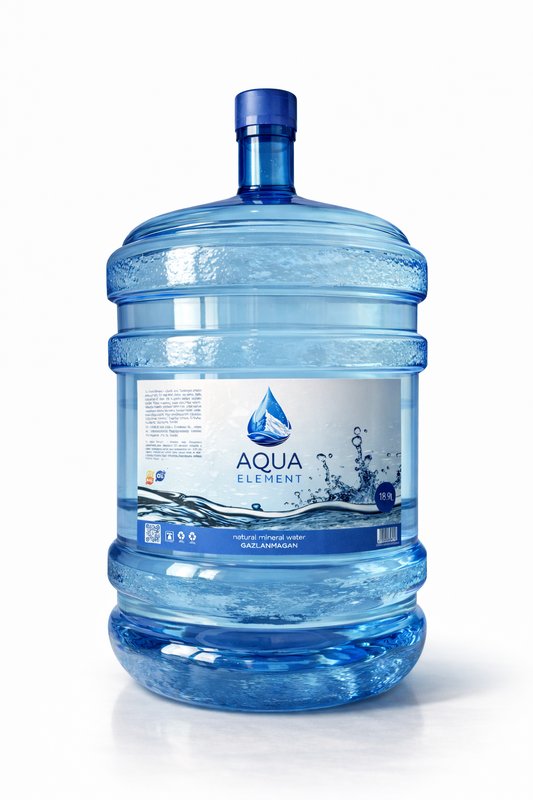
- 18.9 L — the standard returnable polycarbonate bottle used widely in Uzbekistan and the CIS. Fits coolers, manual pumps and dispensers. Collected by the courier on the next delivery, washed, sanitised and returned to circulation.
- 10 L — a compact format for households that do not need or cannot host a cooler. Used like a kitchen jug: stored next to the sink or in a lower cabinet, poured via a handle or attachment, easy to fit in a fridge.
Comparison table
| Criterion | 18.9 L (19 L) | 10 L |
|---|---|---|
| Water volume | 18.9 litres | 10 litres |
| Approximate weight when full | ~19 kg water + ~1 kg bottle ≈ 20 kg | ~10 kg water + ~0.4 kg bottle ≈ 10.4 kg |
| Cooler / pump compatible | Yes, standard neck | No, format not designed for coolers |
| Returnable | Yes, collected on next delivery | Convenience format; check current label or contact /contact for current return policy |
| Best for | Families of 2+, offices, homes with a cooler | Single people, couples, kitchens without a cooler |
| Storage footprint | Full-size spot beside a cooler | Fits a lower cabinet, shelf next to the sink |
| Recommended use after opening | Use within 7–10 days at room conditions | Use within 7–10 days at room conditions |
How much water your household actually drinks
Before picking a format, it helps to estimate weekly consumption. The numbers below are practical guides based on a typical drinking-water need of 1.5–2 litres per person per day, plus tea, coffee and cooking.
One person
Roughly 8–14 litres per week — meaning 10 L usually lasts 5–7 days. A 19 L bottle for a single person makes sense only if you cook a lot, work from home, run a cooler, or host frequently. Otherwise 10 L is more comfortable: less weight, smaller footprint, no dispenser required.
A couple
Consumption is around 16–25 litres per week. A 19 L bottle is a typical 5–10-day supply. If both of you cook regularly, subscribing to one 19 L per week or one every ten days is the natural choice. The alternative is two 10 L bottles per week, but per-litre that costs more.
Family of 3–4
This is the sweet spot for the 19 L bottle. With weekly demand of 30–55 litres, one 19 L bottle lasts 4–7 days. The most common subscription is two 19 L bottles per week, or three every two weeks. Families with small children and heavy cooking often take two at once so the second one is on standby.
Family of 5+
This pushes you firmly into multi-bottle delivery territory. Several 19 L bottles per drop strike the best balance between weight handling, delivery frequency and per-litre cost. 10 L makes little sense here — you would deal with empty bottles too often.
Office
For an office the answer is almost always 19 L on a cooler. It is the industry default: hot and cold water on a button, staff do not carry mugs to the kitchen, and you can pour for a guest immediately. 10 L in an office only makes sense in a 1–2-person studio or as a temporary fill-in while the cooler is being serviced.
Cooler or no cooler: the deciding question
This is probably the most practical criterion. If you already have a cooler, manual pump or table-top dispenser with the standard 55 mm neck, take 19 L — otherwise the equipment sits idle. If there is no cooler and no good place for one (limited space, design preferences, no need for hot water), 10 L solves the same problem more simply.
People usually buy a cooler for three reasons: hot water without a kettle, cold water without using the fridge, and constant shared access — convenient for families and almost mandatory in offices. If none of those three drivers feels essential, you do not need a cooler: a 10 L bottle plus a fridge carafe handles the job just as well.
What to do if you do not have a cooler yet
Many customers begin with 10 L to test taste and delivery logistics, then move to 19 L a month later — usually with a cooler or manual pump. Subscription lets you change format without renegotiating: start with one 10 L per week, then switch to 19 L or a mix.
The returnable-bottle programme: how it works
The 18.9 L bottle is returnable. In practice you buy the water, while the bottle keeps cycling between you and the delivery service. The cycle looks like this:
- The courier delivers the full bottle and collects the empty one from the previous drop.
- The empty tare goes through the wash line: external and internal cleaning, rinsing, inspection for chips and microcracks.
- The bottle is sanitised, leak-tested, refilled with fresh water, sealed with a heat-shrink cap and routed back to delivery.
- If the bottle is damaged, it is taken out of circulation. Polycarbonate goes to recycling.
A returnable system beats single-use packaging on two fronts. Environmentally: a single 19 L bottle replaces dozens of single-use PET containers over its lifetime. Economically: per-litre cost is lower because you do not pay for new packaging on every delivery.
Per-litre cost: why 19 L is usually cheaper
Without quoting numbers (current prices live on /shop), the logic is straightforward. Every delivery has a fixed component: the bottle itself, transport, the courier's time. That fixed part barely depends on volume. When you pay for 19 L, that fixed part is spread across 19 litres; for 10 L, across 10. So unit cost per litre tends to be lower in the 19 L format.
But "cheaper per litre" is not the only criterion. If you live alone and cannot finish 19 L within the recommended window after opening, there is no real saving — the water loses freshness. In that case 10 L wins on actual consumption even if the per-litre price is slightly higher on paper.
Storage and handling
The rules are the same for both formats:
- Store upright on a flat surface so the cap stays sealed.
- Keep away from direct sunlight and heat. Ideal range — below 25 °C, in a dry, ventilated spot.
- Do not place near strong odours (household chemistry, paint, pungent spices). Polycarbonate does not let water leak, but airborne odours around the bottle can affect perceived taste.
- The label shows the bottling date. After opening we recommend using the water within 7–10 days — it remains safe longer, but taste and dissolved-oxygen profile evolve over time.
- Before placing the bottle on a cooler, wipe the neck with a clean cloth and remove the heat-shrink cap only at the moment of installation.
How to switch and mix formats
Aqua Element subscriptions are flexible. Within one account you can:
- Order only 19 L — the most common choice for families and offices.
- Order only 10 L — for single people and small kitchens.
- Mix formats: for example two 19 L for the main supply plus one 10 L to live in the fridge or in a child's room.
- Adjust schedule and quantity straight from the Telegram bot: @aqua_element_bot.
Returning the empty 19 L bottle is automatic — the courier collects it on the next delivery, no separate request or phone call needed.
How Aqua Element keeps quality consistent across both formats
Whether you choose 19 L or 10 L, the bottle holds the same artesian water from the same filling line. The mineral profile is set by the source: TDS 30–50 mg/L, calcium 10–60, magnesium 7–20, sodium 5–15, bicarbonates 50–120 mg/L. Treatment runs through eleven stages — from quartz filtration and activated carbon to reverse osmosis, UV, mineralisation and ozonation. Every batch is controlled under the requirements of Uzbekistan's Sanepid (Committee for Sanitary and Epidemiological Wellbeing).
What changes between formats is packaging, logistics and use-case. Water quality does not.
Three typical scenarios
"I live alone, no cooler"
Start with one 10 L bottle per week. If you do not finish it, move to one every ten days. If, on the contrary, you run out — switch to one 19 L every 1.5–2 weeks plus a manual pump.
"Family of four, we cook a lot"
Two 19 L per week on a subscription. A cooler simplifies daily life: hot water for tea and porridge, cold water in summer. Empty-bottle return happens automatically.
"Office of 8–15 people"
Strictly 19 L on a cooler. A useful starting estimate is one bottle per five people per week. The simplest way to set up a subscription is via the bot; the schedule gets fine-tuned based on real consumption.
Frequently asked questions
How heavy is a full 19-litre bottle?
About 20 kilograms: 19 kg of water plus roughly 1 kg of polycarbonate. That is why the courier carries the bottle to your floor, and on a cooler it is most comfortable to mount with a pump or stand.
Do you sell coolers?
Equipment rental and sales (coolers, pumps, dispensers) — check /shop and the Telegram bot, the line-up is updated periodically.
Can I subscribe to just one 19 L per week?
Yes. The minimum subscription is one bottle per delivery. You pick the cadence (weekly, every ten days, fortnightly).
What if my bottle is leaking?
Do not use it. Call support or message the Telegram bot. We will replace the bottle on the next delivery without extra conditions.
Is the 10 L bottle returnable?
The 10 L is positioned as a convenience format for kitchens and 1–2-person households. Its returnability follows current operational policy — actual conditions are printed on the batch label or can be confirmed via /contact.
Can I mix 19 L and 10 L in one subscription?
Yes. The subscription supports any combination of formats and quantities per delivery.
How long can I keep an opened bottle?
We recommend using the water within 7–10 days after opening, keeping the bottle closed between uses, and storing it upright in a cool place out of direct sunlight.
Do you deliver only inside Tashkent?
Yes, Aqua Element serves Tashkent city and Tashkent Region. We do not currently deliver to other regions.
Which water is better for small children and cooking porridge?
Both formats are equally suitable — same artesian source, TDS 30–50 mg/L and a balanced mineral profile. Families with children typically find 19 L on a cooler more convenient: hot water is always at hand.
How do I order for the first time?
Through the website at /shop, via the Telegram bot @aqua_element_bot, or by phone. After the first delivery the easiest step is to switch to a subscription tailored to your real consumption.
Ready to choose?
If you are unsure, start with the format closest to your scenario: one person without a cooler — 10 L; a household of two or more, or an office — 19 L. After two or three deliveries you will see the real consumption pattern and can adjust the subscription. Place your first order on /shop, and configure a flexible schedule on /subscriptions or in the Telegram bot @aqua_element_bot.