Artesian, spring, tap, distilled, RO: what's the real difference?
The word "artesian" appears on so many bottled-water labels that it almost reads like a synonym for "premium." In hydrogeology, however, it is a strict term that describes a specific type of underground source. In this guide we walk through what artesian water actually is, how it differs from spring, tap, distilled and reverse-osmosis water, and why the choice of source genuinely matters in Tashkent and the Tashkent Region. Aqua Element draws water from an artesian well roughly 120 metres deep in the Quyi Chirchiq District and sends it through an 11-stage purification line, so we can speak to the topic from inside the process.
1. A short hydrogeology primer
To understand artesian water we have to start with the water cycle. Precipitation falls on the surface; some runs off into rivers and reservoirs (surface water), and some seeps down through soils and rocks to recharge underground horizons. Groundwater is stored inside aquifers — layers of porous material such as sand, gravel or fractured limestone that can hold and transmit water.
Aquifers split into two broad categories:
- Unconfined (water-table) aquifers sit just below the soil. Their water level matches the local water table and rises and falls with rainfall and seasons. Because they are shallow, they are also more exposed to surface contamination — runoff, fertilisers, urban infiltration.
- Confined (artesian) aquifers are sandwiched between two low-permeability layers (clays, mudstones, dense marls). Water inside them is under pressure built up by the height difference between recharge and discharge zones.
This basic distinction drives every other quality difference we will discuss.
2. What "artesian" really means
Artesian water is water taken from a confined aquifer trapped between impermeable layers. When a well is drilled into it, the pressure pushes the water column above the top of the aquifer; under ideal conditions the well even flows on its own without a pump. The height to which the water rises is called the piezometric or potentiometric surface.
Defining features of artesian water:
- Depth and confinement. The aquifer is sealed above by an impermeable layer that physically blocks direct contact with surface contamination.
- Age and stability. Water in confined aquifers has typically been recharged over decades or millennia; its composition is seasonally stable.
- Natural mineralisation. Long contact with the host rock dissolves calcium, magnesium and bicarbonates; the exact profile reflects the geology.
It is important to remember: "artesian" is a property of the source, not a guarantee of what reaches your glass. Depth alone does not eliminate hardness, iron, manganese or microbiological hygiene concerns at the bottling stage.
3. Spring water
Spring water is groundwater that emerges naturally at the surface where an aquifer intersects the topography. The feeding aquifer can be either unconfined or confined, which is why "spring" is a less strict hydrogeological label than "artesian."
From a consumer perspective:
- Springs are often shallow and stay in contact with the near-surface zone, so their composition can shift after rains and snowmelt.
- Spring water often tastes "alive" and lightly mineralised, but without verified protection from surface contamination its safety is not automatic.
- Reputable bottled "spring" waters are normally micro-filtered and disinfected before bottling, even when the label features a beautiful mountain source.
So "artesian vs spring water" comes down to a simple geological idea: an artesian source is, by structure, better isolated from the surface; a spring source sits closer to it and is more sensitive to its surroundings.
4. Tap (municipal) water
Municipal networks supply water from mixed sources: surface reservoirs, rivers, sometimes shallow groundwater intakes. The water is processed at a centralised plant — typically coagulation, settling, filtration and disinfection (usually chlorine, sometimes ozone or UV).
Between the plant and your tap, water travels through kilometres of mains, building risers and indoor plumbing. This introduces the typical issues of municipal supply:
- Residual chlorine — needed for disinfection, but recognisable in odour and taste.
- Secondary contamination — rust particles, biofilms in older pipes, occasional pressure drops during repairs.
- Seasonal variability linked to floods, maintenance and source conditions.
This does not mean that Tashkent's tap water is "bad" — at the plant outlet it is normally compliant. But the kilometres of infrastructure between the plant and your kitchen are outside your control.
5. Distilled water
Distilled water is produced by boiling water and condensing the steam. The process leaves behind almost all dissolved salts, minerals and most organic compounds. The result is essentially pure H₂O with a flat, neutral taste.
Characteristics:
- Near-zero mineralisation (TDS close to zero).
- Empty, slightly unpleasant taste because of the absence of salts.
- Common uses — laboratory glassware, batteries, irons, humidifiers, some pharmaceutical applications.
Distilled water is not a typical drinking water. The drinking-water hygiene literature generally treats long-term consumption of mineral-free water as undesirable, especially with a mineral-poor diet. It sits at the extreme end of the "fully mineralised vs fully demineralised" spectrum.
6. Reverse-osmosis-only water
Reverse osmosis (RO) is a technology that pushes water through a semi-permeable membrane under pressure. The membrane retains most dissolved salts, heavy metals, bacteria and a large fraction of organic compounds. RO essentially imitates osmosis in reverse.
When people say "RO water" they usually mean output from a domestic or industrial RO unit. Important nuances:
- The feed can be any water — tap, well, spring. RO does not by itself say anything about the origin.
- Pure RO permeate has very low TDS and is chemically close to distilled water. For drinking it is normally re-mineralised with calcium, magnesium and bicarbonates.
- RO removes the bad and the good alike. That is why a properly designed line includes a mineralisation step after the membrane.
7. Comparison table
| Type | Source description | Typical mineral content | Typical exposure | Treatment usually applied | Notes |
|---|---|---|---|---|---|
| Artesian | Confined aquifer between impermeable layers, deep well | Moderate, stable | Hardness, iron, manganese; bottling hygiene | Mechanical filtration, optional softening, disinfection | Geologically isolated from surface contamination |
| Spring | Natural surface emergence of groundwater | Low–moderate | Seasonal surface impact | Mechanical and microbiological treatment | Confinement depends on the specific spring |
| Tap (municipal) | Surface reservoirs, rivers, sometimes shallow wells | Moderate, variable | Residual chlorine, pipe rust, secondary contamination | Centralised plant: coagulation, filtration, chlorination | Tap-side quality depends on the network |
| Distilled | Any feed water after evaporation and condensation | Very low (~0) | Lack of minerals, flat taste | Distillation | Not recommended as everyday drinking water |
| RO-only | Any feed pushed through a membrane | Very low | Lack of minerals | Reverse osmosis | Without re-mineralisation, taste and value drop |
| Aqua Element | ~120 m artesian well, Quyi Chirchiq District | TDS 30–50 mg/L, balanced profile | Controlled at every stage | 11 stages: quartz, carbon, ion exchange, regeneration, PP 5/1 µm, RO, CIP, UV, mineralisation, ozone | Artesian source plus full controlled line |
8. Tashkent and the Tashkent Region: why an artesian source is meaningful here
The Tashkent Region has a sharply continental climate with hot summers and variable snow-and-rain river recharge. Surface waters such as the Chirchiq and the regional reservoirs experience seasonal swings in turbidity, anthropogenic load and temperature. In densely populated districts, shallow water-table aquifers are often in contact with zones of human activity.
In this setting, a confined (artesian) aquifer separated from the surface by an impermeable layer offers concrete advantages:
- Composition is more stable across seasons.
- Direct hydraulic connection to surface contamination sources is geologically limited.
- Temperature at depth is constant, which simplifies microbiological control.
This is not a magic shield: a deep well can still carry elevated hardness or natural iron. But the starting conditions for producing drinking water from an artesian source are objectively better than from a surface intake.
Aqua Element's geography
Aqua Element's well is located in the Quyi Chirchiq District of the Tashkent Region at a depth of approximately 120 metres. According to publicly available regional geological information this depth typically corresponds to a confined aquifer overlain by impermeable deposits, separated from shallower water-table groundwater.
9. How Aqua Element fits in
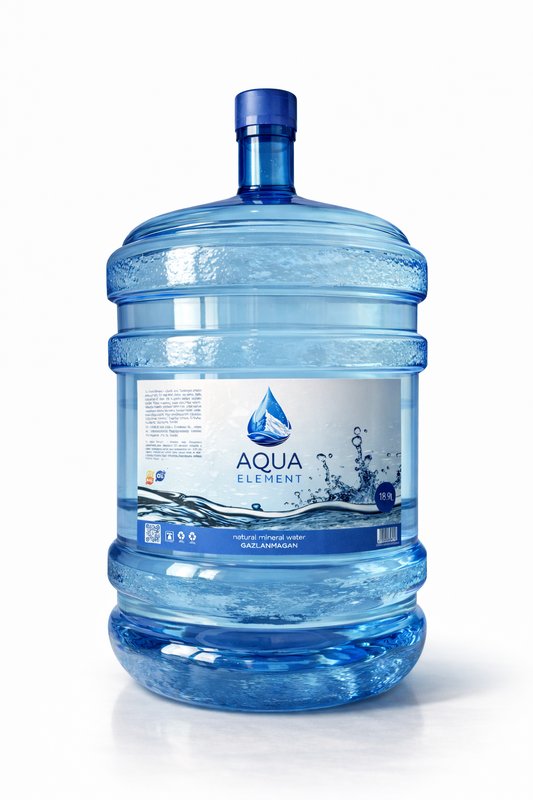
Aqua Element is a useful illustration of how "artesian" turns into a finished drinking water. The deep source on its own is only a starting raw material. After it comes the 11-stage filtration line:
- Quartz filtration — coarse mechanical filtering.
- Activated carbon — chlorine, organics, odours.
- Ion-exchange softener — hardness reduction.
- Resin regeneration — capacity maintenance.
- PP 5 µm — fine mechanical filtering.
- PP 1 µm — even finer filtering.
- Reverse osmosis — heavy-metal salts, nitrates, residual organics.
- Membrane CIP — hygienic cleaning.
- UV disinfection — chemical-free hygiene step.
- Mineralisation — restoring Ca, Mg and bicarbonates.
- Ozonation — final microbiological barrier before bottling.
The result is water with a TDS of 30–50 mg/L, pH around 7.5 and a balanced profile of calcium, magnesium, sodium and potassium — soft, but not "empty." It is available in 18.9 L returnable and 10 L formats via the shop, with the option of recurring delivery through a subscription.
10. Summary
"Artesian" is not a marketing word but a precise geological situation: water from a confined aquifer between impermeable layers, isolated from surface contamination. Spring water sits closer to the surface and is more sensitive to its surroundings. Tap water is centrally treated but exposed to the network on its way to your tap. Distilled and "pure" RO are nearly mineral-free and need re-mineralisation for everyday drinking. Aqua Element combines an artesian source with a fully controlled treatment line so that every bottle behaves the same way.
FAQ
Is all artesian water safe without treatment?
No. A confined aquifer is well isolated from the surface, but that does not eliminate natural hardness, possible iron, manganese, or the microbiological risks introduced during operation and bottling. Even artesian water needs proper monitoring and multi-stage treatment.
How deep is the Aqua Element well?
About 120 metres, in the Quyi Chirchiq District of the Tashkent Region — a deep horizon that is typically confined.
What is the difference between confined and unconfined aquifers?
An unconfined (water-table) aquifer sits near the surface; its level matches the local water table. A confined (artesian) aquifer is trapped between two impermeable layers and stores water under pressure that rises above the top of the aquifer when tapped.
Is spring water always cleaner than tap water?
Not necessarily. It depends on the specific source and the state of the municipal network. Some springs are excellent; others are vulnerable to seasonal surface contamination.
Why does Aqua Element still use reverse osmosis if the source is artesian?
Because depth reduces surface risks but does not guarantee a perfect salt or microbiological profile in the bottle. RO removes residual heavy metals, nitrates and other potential contaminants; afterwards the water is re-mineralised to a target profile.
What does "artesian" on a label mean?
Technically, that the water is taken from a confined aquifer overlain by an impermeable layer. In practice you verify it through certificates, the well passport and Sanepid documentation.
Is bottled water always from a spring?
No. Bottled water can come from artesian, spring, treated municipal or re-mineralised reverse-osmosis sources. The source type is normally listed on the label.
Can you drink distilled water every day?
Daily distilled water is not a great choice. Distilled and non-mineralised RO lack beneficial salts; for everyday consumption, naturally or restored-mineralised water is generally preferred.
Where can I order Aqua Element?
Through the shop, the Telegram bot @aqua_element_bot, or by phone. Read more about the process at /process/11-step-filtration.
How does Aqua Element differ from generic "RO water"?
Source: an artesian well at about 120 metres rather than a tap. Process: 11 stages with re-mineralisation rather than a single membrane. Oversight: laboratory monitoring under the Sanepid regulator.
Want to taste the difference? Place an order at /shop or read the full process at /process/11-step-filtration.