
Water mineralisation: why it matters and what TDS to look for
When you pick up a bottle of drinking water, the label often shows numbers: total mineralisation, TDS, pH, calcium and magnesium content. For some buyers it's a set of technical symbols; for others it's the main selection criterion. In this article we'll calmly, without marketing exaggeration, explain what water mineralisation means, why it matters, what TDS values are typically considered acceptable, and why reverse-osmosis water without subsequent remineralisation is so often described by tasters as "flat" or "empty". You'll also find a comparison table, an FAQ block, and the published mineral profile of Aqua Element — our artesian water from Tashkent Region.
What "mineralisation" means in drinking water
In a drinking-water context, mineralisation refers to the naturally dissolved minerals that water acquires as it travels through rock and aquifers. Truly mineral-free water is almost non-existent in nature: even a raindrop, on its way down, dissolves part of the atmospheric carbon dioxide and becomes a weak carbonic-acid solution; once it filters through soil and stone, it picks up calcium, magnesium, sodium, potassium, bicarbonates, sulfates, chlorides, fluoride and trace elements.
Artesian water is a particular and important example. It forms in a confined aquifer protected from above by impermeable layers, and typically has a stable mineral profile. It is from such a confined aquifer, at roughly 120 metres depth in Quyi Chirchiq District of Tashkent Region, that the water you know as Aqua Element is drawn.
Mineralisation is not "additives" or "chemicals". It is a natural property of water that, first, shapes its taste and, second, contributes to its physiological adequacy.
TDS: what it is and how it's measured
TDS stands for Total Dissolved Solids — the sum of all inorganic salts and a small amount of organic substances dissolved in water, expressed in milligrams per litre (mg/L) or the equivalent ppm (parts per million).
There are two main ways to measure TDS:
- Gravimetric method — a water sample is evaporated and the dry residue weighed. This is the most accurate, laboratory-based approach.
- Conductivity-derived method — electrical conductivity of the water is measured and converted to TDS using an empirical coefficient. Pocket TDS pen-meters work this way. Convenient, but less accurate, and sensitive to temperature and salt composition.
Various public-health publications cite approximate TDS categories. They are not strict regulatory thresholds, but a convenient way to describe a water's "character":
- Below 50 mg/L — very low mineralisation (close to distilled).
- 50–150 mg/L — low mineralisation.
- 150–300 mg/L — medium mineralisation.
- 300–500 mg/L — elevated mineralisation for everyday water.
- 500 mg/L and above — approaching the upper bounds of what many public guidelines consider typical for routine drinking water.
Recommendations from the World Health Organization and a number of national regulators, including local Sanepid-style bodies, generally do not set a strict lower limit on TDS, but note that very low-TDS water tends to be perceived as "flat" or "empty" and may be less preferable for steady daily consumption.
Why minerals in water matter
There are three practical reasons fully demineralised water isn't the best choice for everyday drinking.
1. Taste
Water's taste is shaped precisely by dissolved minerals and gases. Calcium and bicarbonates give water "roundness", magnesium adds a slight bitter edge, sodium becomes salty at higher concentrations, and dissolved CO₂ produces a refreshing tang. Fully demineralised water is consistently described in different languages with the same words: "flat", "empty", "blank". This is not prejudice — it's how taste receptors actually work.
2. Calcium and magnesium contribution
Drinking water isn't the main source of calcium and magnesium in the diet, but it's a noticeable one. Various public estimates suggest it can cover a few percent of the daily intake, especially for people who drink 1.5–2 litres a day. Calcium matters for bone tissue and neuromuscular signalling; magnesium is involved in cardiovascular function and hundreds of enzymatic reactions. Water with a reasonable level of Ca and Mg simply doesn't strip the body of this background contribution.
3. Sodium control
Sodium, on the other hand, tends to be over-consumed in most modern diets. So in drinking water, low sodium is valued — typically below 20 mg/L, ideally a single-digit number. This is especially relevant for people with hypertension and for young children.
The "flat" water problem after reverse osmosis
Reverse osmosis (RO) is a powerful membrane technology that removes up to 95–99% of dissolved substances from water: salts, heavy metals, nitrates, pesticide residues, many organic contaminants. It's a very useful step in modern water treatment, and without it consistent quality is hard to guarantee. But there's a downside: along with unwanted substances, RO also strips out the helpful minerals — calcium, magnesium, bicarbonates.
If you bottle water straight after RO, its TDS will be around 5–15 mg/L, pH often slightly acidic, and the taste characteristically "flat". This is exactly why professional bottled-water producers add a separate mineralisation stage after RO: a controlled return of calculated amounts of calcium and magnesium. It is not "chemistry for the sake of chemistry" — it's a correction that restores both taste and physiological adequacy.
Drinking water pH: what's considered normal
pH is a measure of acidity or alkalinity on a 0-to-14 scale, with 7 being neutral. Drinking water in most international and national guidelines typically falls within 6.5–8.5. Within this range water is comfortable to drink and doesn't react undesirably with plumbing or fixtures.
A slightly alkaline pH (7.3–7.8) is common in natural artesian waters and pairs well with a stable bicarbonate buffer. Claims that "alkaline water cures things" or "alkalises the body" are an over-simplification: blood pH is tightly regulated by the body's own buffer systems, and water with pH 7.5 doesn't turn the blood alkaline. That said, a slightly alkaline pH on its own is a normal characteristic of waters with a natural mineral background.
Aqua Element's mineral profile
We publish Aqua Element's mineral profile openly because we believe a buyer has the right to know what they drink every day.
- TDS: 30–50 mg/L — low-mineralisation category. A deliberate choice: a light, easy-drinking water for large daily volumes.
- pH: around 7.5 — slightly alkaline, in the middle of the typical drinking-water range.
- Calcium (Ca): 10–60 mg/L.
- Magnesium (Mg): 7–20 mg/L.
- Sodium (Na): 5–15 mg/L — low, which is desirable for everyday drinking.
- Potassium (K): 1–4 mg/L.
- Bicarbonates (HCO₃): 50–120 mg/L — providing a carbonate buffer.
- Sulfates (SO₄): 10–30 mg/L.
- Chlorides (Cl): 5–10 mg/L.
What does this mean in practice? It's a water with a light, neutral taste, no pronounced bitterness or saltiness, a noticeable but moderate presence of calcium and magnesium, very low sodium, and a stable slightly-alkaline pH. It works well for high daily intake and for cooking, without overwhelming the flavours of meals or beverages.
Comparison table: how different waters look by profile
To make Aqua Element's place easier to see, here's an indicative comparison. It does not replace a laboratory analysis of a specific sample, but it gives a useful overview.
| Water type | TDS, mg/L | pH | Ca / Mg | Taste | Daily drinking |
|---|---|---|---|---|---|
| Aqua Element (artesian, 11-stage) | 30–50 | ~7.5 | present, moderate | light, balanced | yes |
| RO only, no remineralisation | 5–15 | ~6.5–7.0 | almost absent | "empty", flat | not optimal |
| Tashkent municipal tap (general) | — | — | present, varies | varies by district / season | after boiling / filter |
| Generic bottled spring water | 100–500 | 7.0–8.0 | present, varies | light to pronounced | yes, with a suitable profile |
| Distilled water | <5 | ~5.5–7.0 | absent | "empty" | not for daily drinking |
A "—" entry means real values vary too much by district and season for us to publish a single fair average.
How Aqua Element reaches this profile: 11 stages
To deliver this stable, low-mineralisation but not "empty" profile, our artesian raw water passes through 11 sequential preparation stages. The full breakdown lives on the dedicated page 11-step filtration; here's a short overview.
- Quartz filter — mechanical removal of larger particles.
- Activated carbon — sorption of chlorine, organics, off-tastes and odours.
- Ion exchanger / softener — hardness reduction.
- Softener regeneration — restoring the sorbent.
- Polypropylene 5 µm — fine mechanical filtration.
- Polypropylene 1 µm — final mechanical filtration.
- Reverse osmosis (RO) — removing 95–99% of dissolved substances.
- Membrane CIP wash — preserving RO lifespan and stability.
- UV disinfection — inactivating microorganisms.
- Mineralisation — controlled reintroduction of Ca and Mg into the post-RO water. This is the stage that makes the water "full" in taste and physiologically adequate.
- Ozonation — final microbiological safeguard before bottling.
Stage ten is the key one for the topic of this article. Without it, post-RO water would be technically very clean but flat in taste and almost empty of calcium and magnesium. With it, we land at a stable profile of 30–50 mg/L TDS, pH 7.5, and a meaningful presence of Ca and Mg.
How to use this when choosing water
- For high daily volumes (1.5–2 litres a day or more), a TDS roughly between 50 and 300 mg/L, low sodium and a pH between 7.0 and 8.0 are reasonable targets.
- For young children, low sodium and a controlled, transparent profile matter even more.
- "Higher TDS is always better" is a myth. Highly mineralised waters (above 1000 mg/L) are medical-table or therapeutic waters, with their own indications and contraindications, and aren't meant to be consumed unlimited every day.
- "Lower TDS is always cleaner" is also a myth. Distilled water is indeed clean but not optimal for steady consumption.
Aqua Element: transparent and easy to order
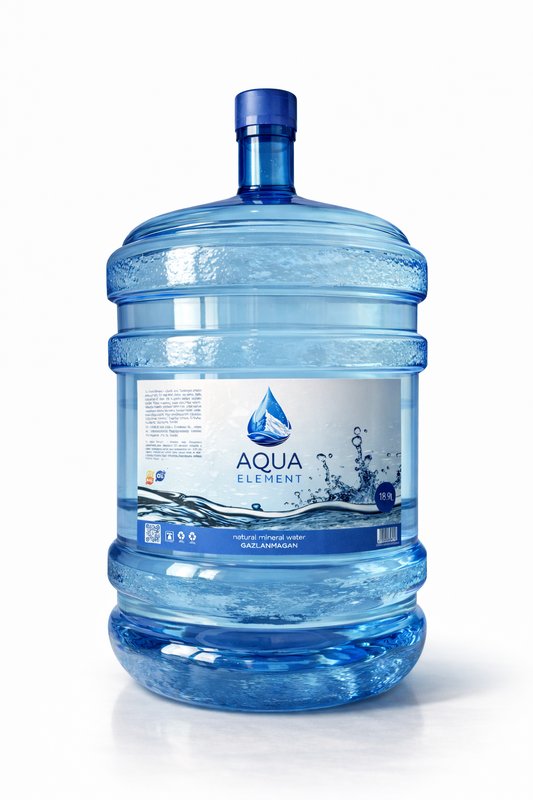
We want every buyer in Tashkent and Tashkent Region to have an easy path to water with a clearly published mineral profile. You can order an 18.9 L returnable bottle or a 10 L pack from our shop, and regular drinkers can set up a delivery subscription on a fixed schedule. Logistical questions about packaging and returns are collected in the water-delivery FAQ.
For more on quality standards and the regulatory requirements we comply with, see Quality Standards; for the company behind the brand, see About.
Frequently asked questions (FAQ)
What TDS is right for daily drinking water?
Many public guidelines and reviews consider a range of roughly 50 to 300 mg/L comfortable for everyday drinking water. Aqua Element sits at about 30–50 mg/L — the low-mineralisation category, which is convenient for high daily intake.
Why does some water taste "empty"?
Most often it's water that has been through reverse osmosis without subsequent remineralisation, or it's distilled water. There are very few dissolved minerals, so taste receptors don't get their usual "anchor points". This is exactly why a careful producer adds a mineralisation stage.
Is high-pH water healthier?
There is no robust evidence in authoritative sources that water at, say, pH 9 or 10 "treats" anything in a healthy adult. A slightly alkaline pH of 7.3–7.8 is a natural property of many mineral waters; there's nothing magical about pushing it higher.
How is mineralisation done after reverse osmosis?
Most commonly post-RO water is passed through a cartridge or column containing calcium and magnesium minerals (often based on calcium and magnesium carbonates), or it is dosed with a mineral concentrate. The result is calibrated against final TDS, Ca, Mg and pH targets.
Can I check TDS with a pen-meter?
Yes, as a rough indication. The pen measures electrical conductivity and converts it to TDS via an approximate coefficient. Precise figures come from a laboratory analysis run by the producer and the regulator.
What's a typical calcium level in good drinking water?
There's no firm lower bound, but many reviews look for a presence on the order of tens of mg/L as a sign of "non-empty" water. Aqua Element ranges 10–60 mg/L for calcium and 7–20 mg/L for magnesium.
Is low-sodium water important?
Yes, particularly for people with elevated blood pressure and for children. Aqua Element keeps sodium to 5–15 mg/L.
Does boiling change TDS?
Boiling on its own doesn't remove most dissolved salts. Some calcium and magnesium can drop out as scale on the kettle, especially in hard water, but the bulk of dissolved solids remains. Boiling is primarily about microbiology, not mineralisation.
How does artesian water differ from regular bottled water?
Artesian water is drawn from a confined aquifer protected by impermeable layers and usually has a stable, repeatable profile. "Bottled" is a packaging category that includes artesian, spring, and treated waters from various sources.
Where can I see Aqua Element's quality data?
On the Quality Standards and 11-step filtration pages. If you still have questions, reach us via Contact or our Telegram bot @aqua_element_bot.
Ready to try it?
We make a water whose profile you don't have to guess: the numbers are public, the technology is documented, and delivery across Tashkent and the region is well-established. Order an 18.9 L returnable bottle or a 10 L pack from our shop, set up a regular subscription, or read about the 11 stages of filtration before you decide.